

LOUISVILLE, Ky. (WDRB) — Churchill Downs is legendary in Louisville.
It's an icon of the horse racing world, but before it was even a glimmer in the eyes of Meriwether Lewis Clark Jr., there were several other racetracks that called Louisville home.
Elm Tree Garden
The first sat on what is now Shippingport Island, home to the McAlpine Locks and Dam and the Ohio Falls Power Plant.
A map from 1856 in the UofL Archives and Records shows Shippingport, a community located on what was then a peninsula. It became an island in 1830 when the canal was finished.
Elm Tree Garden was Louisville's first amusement park, according to the Encyclopedia of Louisville. It opened June 6, 1829, by Frenchman Joseph L. Detiste at the foot of the then 18th Street Canal Bridge.
"The amusement park, which included multiple features, it was built around a giant Elm tree with a platform kind of up and around the tree," said Louisville historian Tom Owen, with UofL.
A tavern was housed around the Elm tree and up into the branches. Underneath it were mazes, puzzle gardens and a racetrack.
In 1831, Detiste added a small train ride to the park and, in 1832, he constructed a China pavilion, pagoda, tree arbor, a dance pavilion and a gondola service.
The park and Shippingport community thrived until February 1832. Flood waters reached up to 41 feet, 5 inches tall, according to a flood map by Standard Printing Co. from 1937.
Elm Tree Garden reopened after that, but never truly returned to its heyday glory, closing in 1837.
Oakland House and Race Course
It could be said that Churchill Downs owes its grandeur and glory to Oakland House and Race Course, the first racetrack to gain national recognition for Louisville.
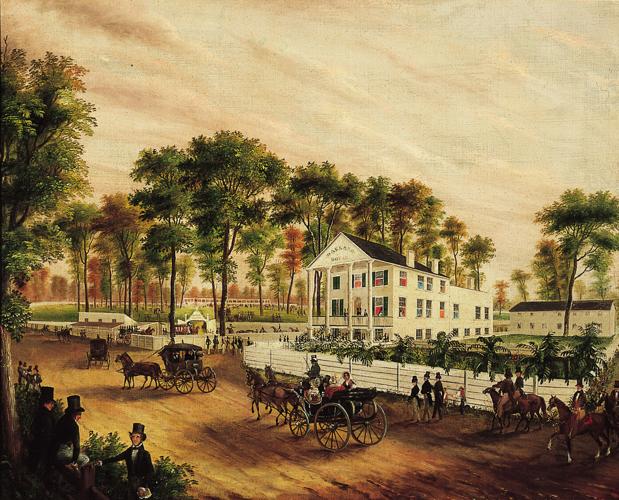
It was built in 1832, surrounded by its namesake trees. On the grounds sat the Oakland House, a three-story Greek Revival building that served as the track clubhouse and visitors' hotel.
The Encyclopedia of Louisville mentioned that the clubhouse welcomed women, and furnished a ladies' room and private pavilion.

Robert Brammer, American, born Ireland, 1811 ‑ 1853
Augustus A. Von Smith, American, born Germany, 1816 ‑ 1859
Oakland House and Race Course, Louisville, about 1840
Oil on canvas
28 5/8 × 36 × 7/8 in. (72.7 × 91.4 × 2.2 cm.)
Purchase, Museum Art Fund
Conservation supported in part by a grant from the National Endowment for the Arts, a Federal agency 1956.19
Historians with the Filson Historical Society said while searching for information about Oakland, they found a legal document prepared in 1877 that researched the title plot of land that Oakland sat on.
"This is a huge industry in Kentucky," said Patrick Lewis, president and CEO of the Filson Historical Society. "Establishing (a) clean real estate title because we see the first date here is 1791, then we get 1792, we've got Virginia state patents here, so this is taking place even before Kentucky statehood.
"Payton Short is the first owner and Maria, his wife, owned that and then handed down through a number of different owners, the Ray family, the McCall family, and then eventually, not surprisingly to the Churchill family who, of course, owned lots of agriculture and plantation land on the south end of town. And of course who will donate sort of the initial funding for Meriwether Lewis Clark when he's going to build what will become Churchill Downs."
In the legal document, there are four women named as shareholders for Oakland in 1839.
"Nancy O'Beirne, Lucy Owen, Sarah Talbot, Mary Anderson," said Jennie Cole, director of Collection Access with the Filson Historical Society. "It says 'I examined Nancy, Lucy, Sara and Mary privily and apart from their separate husbands and having shown and explained said deed to them they declared they had signed sealed and delivered and acknowledged the same of their own free will, innocent without the threats, persuasions or compulsions of their husbands that they were willing, said deed should be recorded.'"
This was documented seven years after the Oakland organization was created. Letters held by the Filson also reveal that Oakland's popularity was widely known.
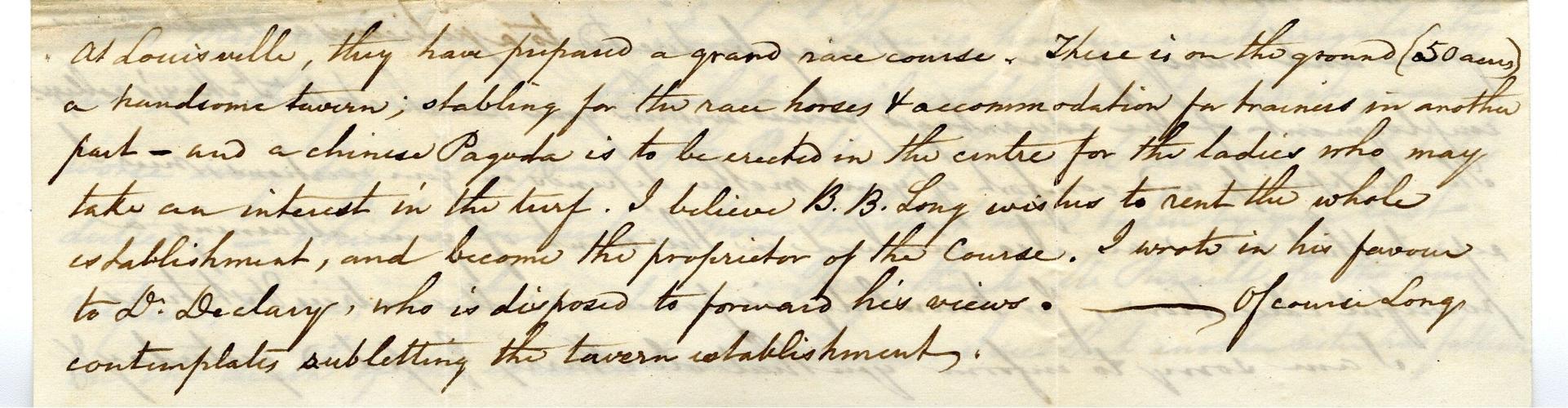
Cole mentions that in a letter, a man named John Dutton writes to another man named John Mason, both of whom are in Maryland, about the racetrack.
"At the very end he tacks on a little part that says 'At Louisville, they have prepared a grand racecourse, there is on the grounds of 50 acres a handsome tavern, stables for the horses and accommodations for trainers in another part,'" said Cole. "'And a Chinese pagoda is to be erected in the center for the ladies who may take an interest in the turf.'"

A letter from a man named John Dutton to another man named John Mason, both of whom are in Maryland, about the Oakland House and Race Course in Louisville. (Courtesy of the Filson Historical Society in Louisville)
Another letter from a woman named James Ann Pierce to her brother William Botley sheds some light on how busy Louisville was back then.
"'The races commenced today and the city is crowded,'" said Cole. "'A great many strangers have been refused at the Galt House and all the other hotels are crowded.'"
The visual of Oakland House and Race Course is a painting, created by Americans Robert Brammer and Augustus A. Von Smith around 1840. The painting is part of the Kentucky collection and housed at the Speed Art Museum on UofL's campus.
Despite Oakland's popularity, it suffered from financial issues in the 1840s.
"So the Oakland Racecourse does not survive until the Civil War as an operating racetrack," Lewis said. "It sort of peters out in the 1850s."
Buildings on the property remained though, and were used when the Civil War began in 1861.
The Filson has in its collection a map from 1865 by the Army Corps of Engineers that shows all the Union army buildings and set-ups in and around Louisville.
"We know from context beyond this map that that's not just a stable that's housing horses that (are) being ridden out on patrols in the hinterland of Jefferson counties, what this actually is, is a horse hospital," said Lewis.
"Everything during the civil war is being pulled by horsepower. There are hundreds of thousands of horses in service with the United States Army as it's pushing down by this time in 1863. The Union army is rotating sick and sort of injured, broken down, worn out horses, who have been pulling these heavy wagons full of ammunition and cannons up and down mountains in east Tennessee and north Georgia back here to refit."
The location was ideal because it was right next to a Louisville and Nashville Rail line, giving soldiers the ability to load and unload cars full of horses into the stables at what was once Oakland.
Woodlawn Race Course
Woodlawn Race Course made its debut in 1895. According to the City of Woodlawn Park's website, the land it sat on was bought by several men who started the Woodlawn Association in 1858.
Two courses were built on the property, one for trotting races and the other for thoroughbred racing. Woodlawn also had two grandstands, one specially for women.
The Civil War also cast a shadow over racing at the course, and it was used as a mustering-out station, according to the City of Woodlawn Park's website.
"Horse racing pretty much stops during the war," said Lewis. "Even though thoroughbreds aren't necessarily the right type of horse for most army uses, all of those horse breeders and horse dealers are so focused on supplying that war effort."
Lewis said the thoroughbred as we know it today was not the ideal horse for almost any of the jobs the U.S. Army had in mind for it.
"Thoroughbreds are racecars," he said. "They are meant to do one thing and that is to go fast for short distances, even though races were much, much longer than they are today."
According to the Encyclopedia of Louisville, many horses broke down during the spring meet of 1866. Interest in horse racing fell and due to financial issues, Woodlawn closed by 1870.
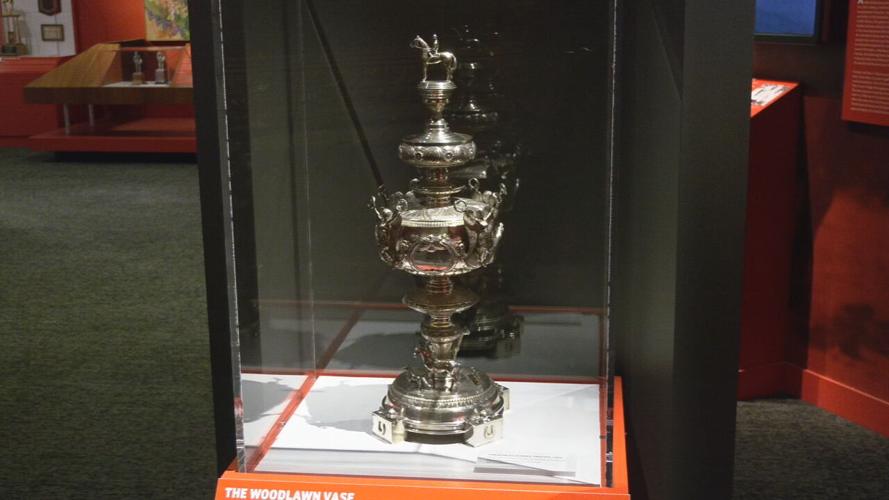
Today, one piece of the track lives on — the Woodlawn Vase, crafted by Tiffany and Co. in 1860. At the time, it cost around $1,000.
Due to the flare up of the war, it was buried to prevent it from being stolen. It was later unearthed and, in 1917, given to the Pimlico Race Course in Baltimore.
Today, the original vase is housed at a museum in Baltimore. A replica is given to the winner of the Preakness Stakes.
Two of those replicas are currently on display at the Kentucky Derby Museum at Churchill Downs.
Greenland Race course
In what is now the Wilder Park neighborhood once stood the Greenland Race Course.
It opened in 1866, according to the Encyclopedia of Louisville. Owen said that while there isn't a lot of documentation about the race course, it is known that it was in Churchill Downs' front yard and that the area was undeveloped in the time after the Civil War.
"It is adjacent to the L&N railroad track to the now CSX railroad track that goes right behind L&N stadium and then heads on out, and so folks got to Greenland by the train," said Owen.
It closed in the mid 1880s and the area became known as Wilder Park. The clubhouse was used as a park pavilion and by the 1890s it was a favorite spot for bicyclists.
Douglas Park Race Course
In the Beechmont community, a trotting track opened in 1895.
Douglas Park was developed by James Douglas and had a grandstand and clubhouse on the property. according to the Encyclopedia of Louisville.
"At times there will be trots there," Owen said. "Harness racing and, at times, there will be thoroughbred racing there."
It closed from 1906 to 1912. Then, in 1913, it was renovated and changed for thoroughbred racing.
It competed with Churchill Downs and was the home of the Kentucky Handicap while it was open.
In 1918, the owners decided to merge with Churchill Downs on common interests and Douglas Park stopped being used as a racetrack. After that, the Kentucky Jockey Club used it as a training area and stables for horses that couldn't be housed at Churchill Downs.
The track remained, but the grandstand and clubhouse fell into disrepair until they were torn down in 1939.
Maraget Merrick writes in the Encyclopedia of Louisville that fires in 1945 and 1951 damaged several of the horse barns.
Then in 1952, another fire completely destroyed the largest horse barn and killed 68 horses.
Churchill Downs purchased the property and started selling bits of land in 1954.
The park officially closed in 1958. The only remaining parts of the park are the pillars to the entrance.
Fairgrounds Speedway Trotting Track
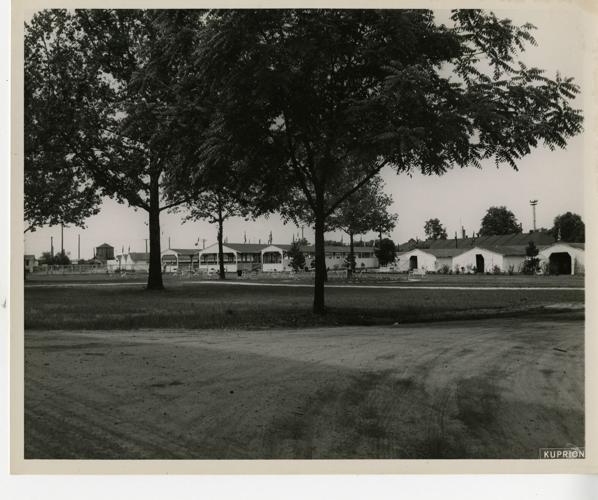
In the west end of Louisville, the Old Kentucky State Fairgrounds held its own with the Fairgrounds Speedway Trotting Track.

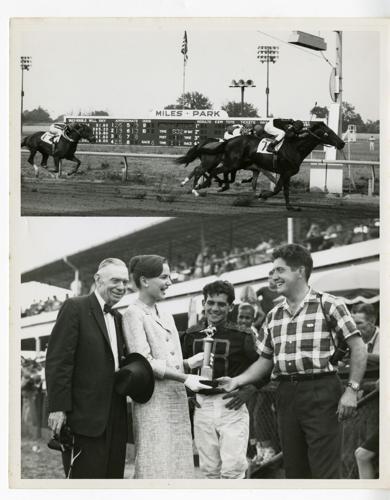
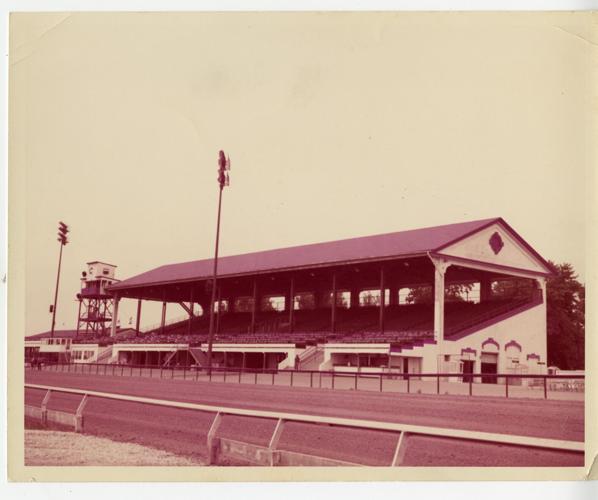
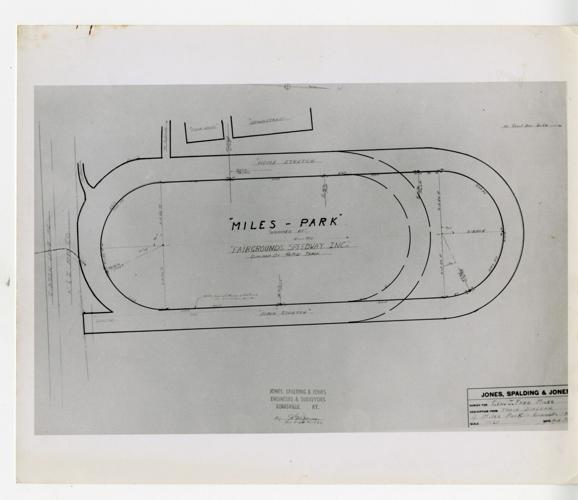
The Fairgrounds Speedway Trotting Track, later transformed into Miles Park, in Louisville. (Courtesy of the Filson Historical Society in Louisville)
"They had harness-racing and then, ultimately, thoroughbred racing. Because when the fairgrounds closed and moved to the Kentucky Fair and Exposition site in 1956, then you had the transformation into Miles Park," said Owen. "And that fairgrounds had an outdoor grandstand and a track. I know, for instance, they had automobile races on that track in the 1920s."
The track was enlarged for thoroughbred racing and renamed after the new owner, an Ashland Oil company founder, J. Fred Miles, according to the Encyclopedia of Louisville.
Miles Park featured the Junior Derby and Oh Susannah Stakes.
In 1962, Miles sold the track. A fire burned up 13 barns in 1964 and killed 26 horses. In 1969, a Buffalo, New York, company took ownership and renovated the park.
"It was renamed in '74 to Commonwealth Racecourse," said Cole.
The last meet at the course was in 1975, and the Kentucky Racing Commission denied the track's request for a summer meet that year. The commission said the decision was due to the owning company's 1972 racketeering conviction. The commission later denied any racing days for the track, saying it didn't attract enough bettors to warrant racing.
Louisville Downs
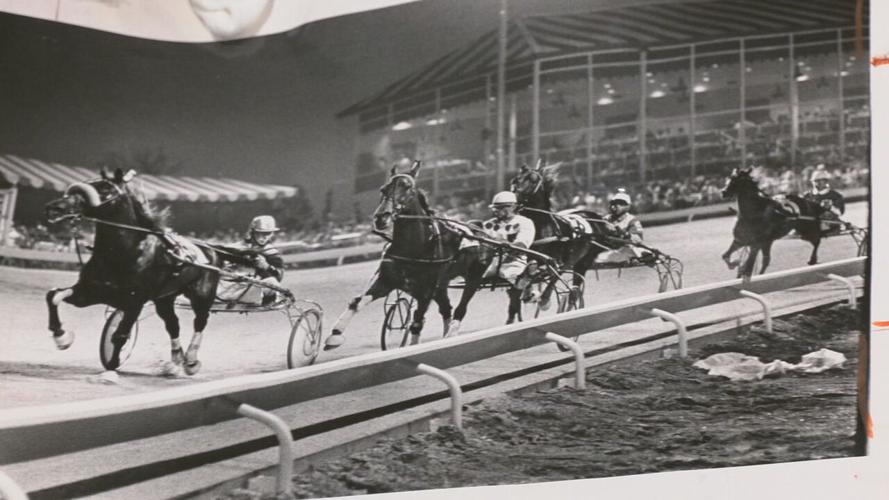
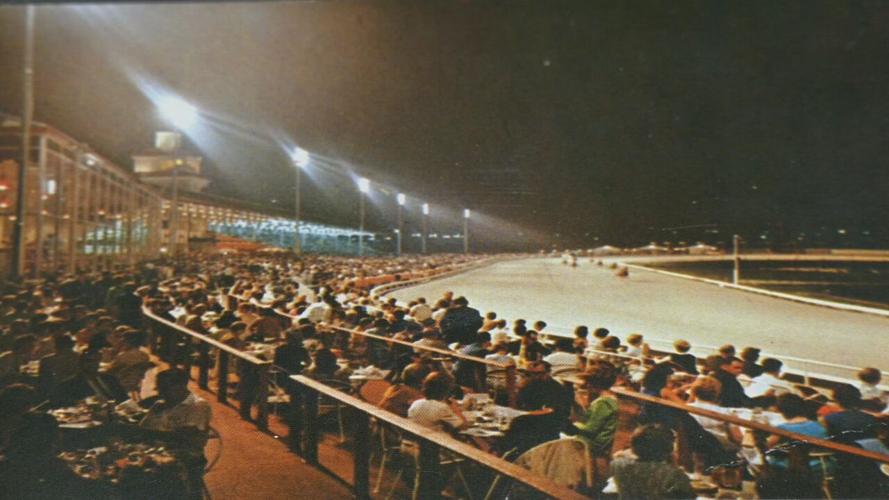
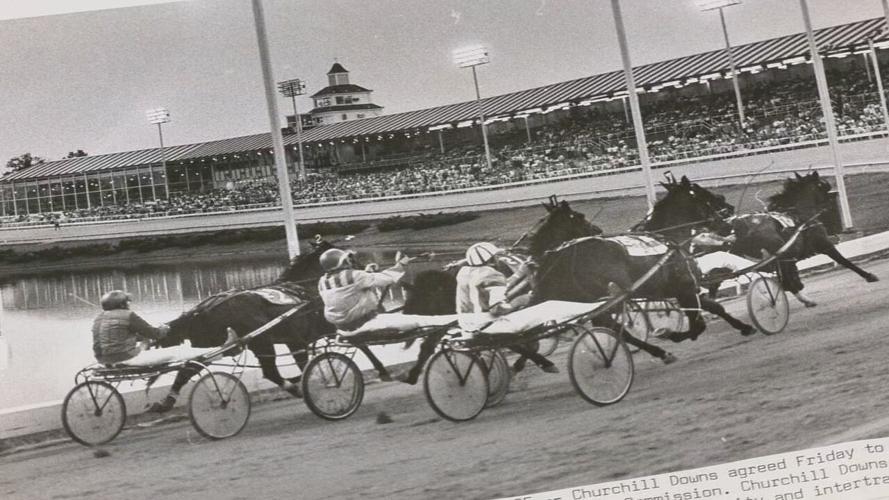
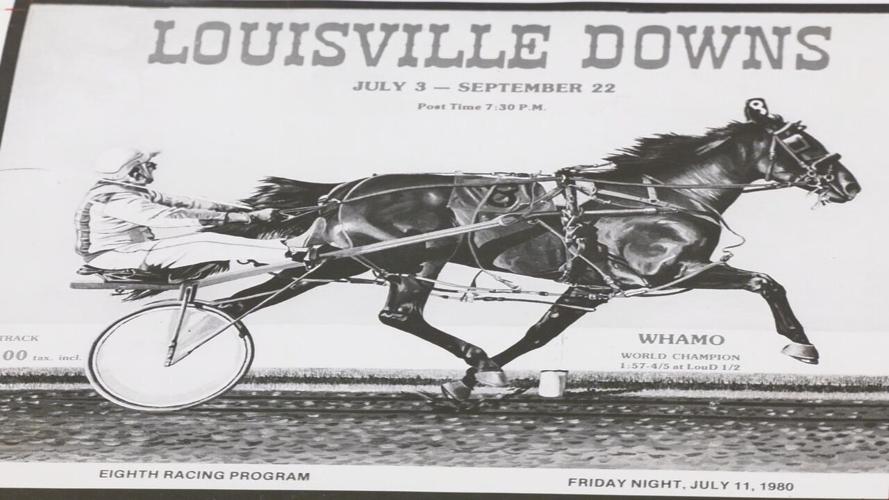
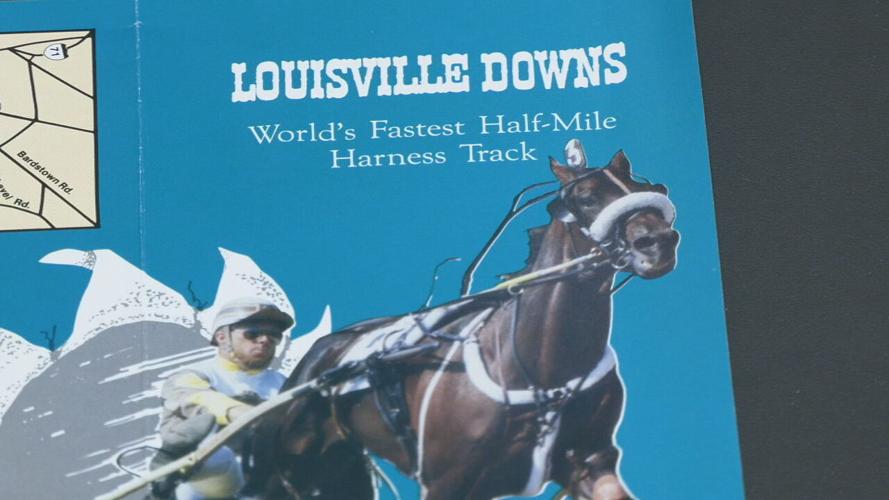
Louisville Downs opened in July 1966 and was the home of the half-mile harness track.
"Developers developed a racetrack with a large, large lake, a shallow lake, associated with it," said Owen.

A photo of horses in harness races at Louisville Downs. (UofL Archives)
The course was known for its crushed limestone racing oval and peppermint-striped, glass-enclosed grandstand, according to the Encyclopedia of Louisville.
It was home to the Kentucky Pacing Derby, considered a huge event in the harness-racing world.
During the track's biggest years from 1976 to 1982, the track averaged more than 3,000 fans.
The first president of the track, William H. King, introduced computerized betting for the track, live cable television coverage and betting specials.
Call-a-Bet was the first bet by phone system in the state of Kentucky and one of the first in the entire nation.
In 1988, Louisville Downs was the first track in the state to accept betting during live racing, known as Sports Spectrum.
Racing at Louisville Downs ended when Churchill Downs bought the track in 1991. To this day, Churchill Downs uses the site as a training facility.
Copyright 2026 WDRB Media. All Rights Reserved.


