


LOUISVILLE, Ky. (WDRB) — The easiest thing to say about Louisville's basketball roster is that it's talented.
That's also the least interesting thing.
Of course it's talented.
Flory Bidunga was one of the most coveted players in the transfer portal. Oregon standout Jackson Shelstad was too. Karter Knox was a five-star recruit. Adrian Wooley is back. Alvaro Folgueiras brings versatility. Gabe Dynes is 7 feet, 5 inches tall, which remains a useful basketball trait.
Louisville | Kentucky | Indiana | Eric Crawford
The more interesting question, sitting here in late May with the roster mostly in place, is this: What exactly is this team?
A year ago, that answer came easily.
Pat Kelsey's first two Louisville teams wanted pace. They wanted possessions. They wanted to pass, move and shoot the three. Last year, nearly 53% of their shots came from three. The Cardinals weren't bigger. They weren't always more talented. But they knew exactly who they were.
This roster feels different. And four questions may ultimately determine what kind of basketball team it becomes.
1. What to think about all this size?
Stand Bidunga, Dynes, Folgueiras and freshman Obinna Ekezie Jr. next to one another and Louisville suddenly looks less like a team built around pace and more like a team built around occupying every inch of the paint.
Bidunga is listed at 6-foot-8 but plays bigger. Dynes is 7-foot-5. Folgueiras is 6-foot-10. Ekezie arrives at 7 feet. Not just in length but in mentality, Louisville suddenly possesses paint presence that simply wasn't there a year ago.
And unlike some tall teams, this one appears capable of moving.
Bidunga averaged 2.6 blocks per game. Dynes blocked shots in limited minutes at USC. Ekezie arrives with a reputation as a rim protector and lob threat. Knox brings size and athleticism on the wing.
Evan Miya, college hoops stat guru, projects Louisville would rank between No. 3 and No. 8 nationally in defense to start the season.
That's different territory. Louisville should be a better rim-protecting team, harder to score against in the half court, and a stronger rebounding team.
But there may be a bigger implication.
Last year's team often won with shooting and flurries of defense. This one may well win with defense and flurries of shooting. If NCAA Tournament games still tend to become half-court wrestling matches by the second weekend, that's not the worst thing in the world.
2. Where does the spacing come from?
This is the question that keeps surfacing every time I study the roster.
Not because Louisville can't shoot. It can. The issue is whether Louisville has enough shooting gravity.
There is a difference.
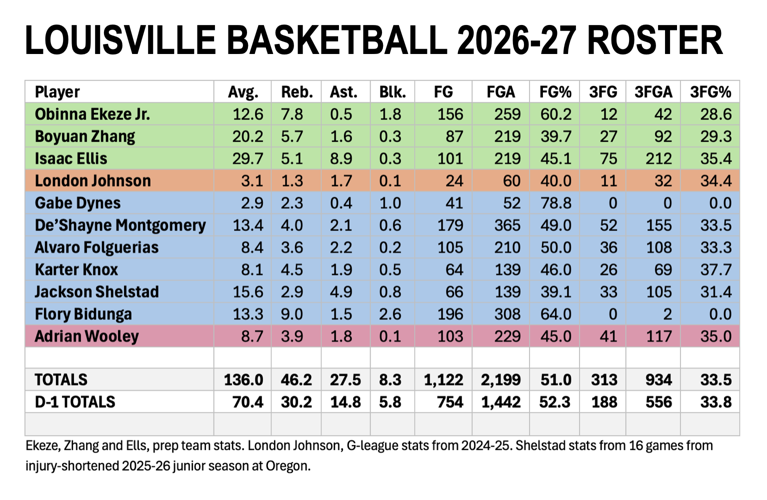
Wooley shot 35% from three last season. Knox shot 37.7%. Shelstad shot 31.4% during an injury-shortened year at Oregon — below what he'd shown as a freshman. Folgueiras shot 33.3% from three at Iowa. De'Shayne Montgomery shot 33.5% at Dayton.

A graphic depicting Louisville basketball players with last available performances. Green shading denotes prep school. Orange is from the NBA's G-League. Blue is NCAA Division I play and purple is the lone player who was at Louisville last season.
Useful pieces. But who is the player opponents refuse to leave? Who changes how defenses behave? Who creates panic when he relocates to the corner or comes off a screen?
That answer isn't immediately obvious.
Louisville's returning players took 42% of their shots from three last season — a 10-point drop from what Louisville did a year ago. (Of course, those numbers are affected by Bidunga and Dynes, who aren't shooting threes.) Still, the better the interior size becomes, the more opponents are going to want to crowd the paint.
The Cardinals may create spacing through pace, cutting, transition offense and athleticism. And the shooters are likely to get good looks.
Then there's this. Kelsey knows the "bubble gum cards" of these guys. And it's dangerous to look at just last season's sample size with some of them. For several, last season was the exception more than the rule.
And viewed through that lens, the picture changes.
Wooley shot 35% from three last season, but he was a 42% shooter as a freshman and has hovered near 39% for his career. Shelstad's 31.4% mark came during an injury-hindered season after he shot closer to 39% the year before. Folgueiras owns a 40% season on his résumé. And Zhang's prep-school numbers in several years of international competition with China are far better.
In other words, Louisville probably has more shooting pedigree than a quick glance at last season's statistics suggests.
3. Why might the freshmen matter more than expected?
Portal-heavy teams can usually afford patience with freshmen. Louisville may not have that luxury.
Isaac Ellis may be the most obvious example. If Louisville needs perimeter creation and additional spacing, Ellis — who reclassified to join the program and made 75 three-pointers while averaging better than 35 points per game at Moravian Prep — could become valuable faster than expected.
Ekezie may find himself in a similar situation. Kelsey's offenses have proven adept at lifting opposing defenses for lob threats, and a 7-foot shot-blocker who can finish above the rim could see his role grow quickly.
Then there's Boyuan Zhang. The scoring numbers are eye-opening. How his game translates to this level is one of the roster's genuinely open questions.
The freshmen aren't merely developmental projects. They may be pieces this team needs.
4. How does Pat Kelsey evolve?
This may be the most fascinating question of all.
Not because Kelsey can't coach this roster. Because this roster may invite him to coach differently.
This team can play bigger lineups. It can offensive rebound. It can defend with length. It can win games without making 12 three-pointers. The best coaches adapt talent to system and system to talent — and this roster may present Kelsey with more options than he's ever had.
He's already signaling as much. The addition of John Andrzejek — who helped build a national championship defense at Florida two years ago — suggests Kelsey has done some genuine self-evaluation.
Last year's Louisville team wanted to score 95. This year's team may need to win 68-62.
And that may actually make it more dangerous in March. Fans love offense in November. NCAA Tournament games become battles of rebounding, rim protection and execution. Louisville appears better equipped for that reality than it has been in years.
So: what exactly is this team?
The talent is obvious. The ceiling is obvious. Louisville looks like a legitimate ACC contender with national expectations.
But the Cardinals remain something of a basketball mystery — not in terms of who the players are, but who they'll be together. That's the question the next several months will answer.
Copyright 2026 WDRB Media. All Rights Reserved.


