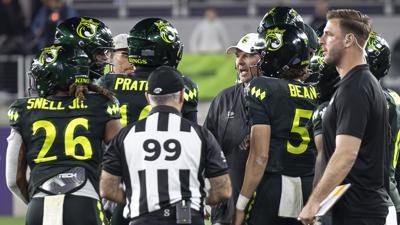

LOUISVILLE, Ky. (WDRB) — It took six days.
Just under a week to take one of the strangest football endings Louisville has ever seen, admit it didn't work, and fix it.
That's not how football usually operates. Football digs in. Football defends itself. Football tells you the rule is the rule and suggests you should have read the fine print more carefully before kickoff.
But the UFL did something different this week. It listened.
And in doing so, it might have shown more awareness than leagues ten times its size.
Because last Friday night, Louisville didn't just lose a game. It lost to a concept.
A concept that sounded reasonable in a conference room — prevent repeated defensive penalties, shorten overtime, protect player safety — but collapsed the moment it met reality.
A football game ended without a football play.
Two penalties. Two flags. Two points awarded. Game over.
Even the broadcast sounded confused. Even the winning team looked unsure. And fans were left trying to process how a game could end without anyone actually scoring.
The rule existed to prevent gamesmanship — the idea that a defense might intentionally foul over and over to avoid giving up a touchdown.
But here's the problem with solving hypothetical problems. Sometimes you create a real one. And the UFL acknowledged it.
The league's head of officiating, Dean Blandino, came out this week and essentially said what everyone watching already knew: you can't end a football game on a penalty. That doesn't work.
So the league changed it.
Now, instead of awarding an automatic score, penalties simply move the ball closer — from the 5-yard line to the 1, then closer still. The offense still has to score. The defense still has to stop them. The game still has to be played.
Simple fix. Better game. More importantly — better ending. Because endings matter.
You can experiment with kickoff rules. You can try four-point field goals. You can eliminate punts in certain situations. The UFL has built its entire identity on being football's laboratory.
But the one thing you cannot experiment with is the integrity of the finish.
Fans will tolerate innovation. They'll tolerate weird. They'll even tolerate a little chaos. They will not tolerate confusion. They will not tolerate feeling like the outcome was decided by something they didn't understand.
And they definitely won't tolerate a game ending like a verdict instead of a competition.
Here's the bigger takeaway, and it's one worth paying attention to:
The UFL didn't just fix a rule. It proved it's willing to listen. That matters for a league still trying to convince people it's worth their time.
Because the worst thing a new league can be is stubborn. The best thing it can be is responsive. And in five days, the UFL turned a punchline into a selling point. It showed players that performance matters more than loopholes. It showed fans that what they're watching will make sense.
And it showed everyone else — including the NFL — that sometimes the smartest thing you can do is admit you got one wrong.
Louisville still has the loss. That won't change.
But the league? The UFL might have gotten a win out of it.
FULL STATEMENT FROM THE UFL'S DEAN BLANDINO:
"We heard you loud and clear. Look, we had good intentions with this rule. It was designed with player safety in mind. These guys are out there for three-plus hours, and we wanted to limit the number of additional snaps in overtime. But the game just can’t end on a penalty. That doesn’t work. And here’s the thing about the UFL, we’re not afraid to change to make the game better. So here’s what’s changing with the overtime rule. If the defense fouls on an overtime try, the ball goes to the one. If they foul again, on any other try, at any point in overtime, the ball goes to the half yard line. If they foul again it goes to the quarter, and so on, and so on. The penalty makes it easier for the offense to score, but it doesn’t automatically award a score. If you want to win, you’ve got to get the ball in the end zone, not rely on your opponent to get a foul. That’s the UFL. We move the game forward."
Copyright 2026 WDRB Media. All Rights Reserved.


