
LOUISVILLE, Ky. (WDRB) – One day after University of Louisville athletic director Josh Heird acknowledged that the school’s basketball program “isn’t into moral victories,” it suffered an unholy thrashing in the first half of a home game against Virginia.
The Cards trailed 41-13 at the half, after falling behind 41-11. It was the third-largest halftime deficit in program history, and the largest since Dec. 10, 1938. The coach then was Lawrence Apitz, and his record in four seasons at Louisville was only 10-52 – though it should be said, he was coaching the football team at the same time.
His winning percentage of .161 isn’t the lowest in school history. Louisville’s first coach, William Gardiner, went 0-3. He gave way to three seasons without a coach in which U of L won 36 percent of its games. Louisville’s sixth coach, John O’Rourke, went 1-13, a winning percentage of .071. All of that (except for Apitz) happened more than a century ago.
Today, Kenny Payne has a winning percentage of .192, a record of 10-42. That’s a lower win percentage then when Louisville had no coach at all. (Of course, it wasn’t facing a Duke team with three projected draft picks then, either.) Last December, after Louisville lost to DePaul, I wrote a column headlined, “This isn’t working.”
Since then, Louisville has played some better basketball. Not consistently. And not good enough to win. But they at least had more respectable moments against some of the better teams in the ACC. But Saturday was a step back. To borrow terms Heird recently used, it was another withdrawal from an already overdrawn account.
Bart Torvik, the analytics guru behind barttorvik.com, an excellent college basketball analytics website, has devised a formula to give each team a performance score with average game margin a major portion of that score. In the loss to DePaul, Louisville scored a 9.
But since DePaul, it had put up some numbers like a 92 in a win at Miami and an 88 in the win over Pepperdine. Even in losses, it scored a 59 in the loss to Wake Forest, and a 44 in the loss to Duke. There also were some lower scores in the 20s and 30s, even a 15 in a loss at Virginia.
On Saturday in the KFC Yum! Center, Louisville scored a 3.
Louisville’s eight ACC losses have been by an average of 15.3 points. A year ago, Louisville’s 18 regular-season league losses came by an average of 14.6 points.
It's not really news to say – and you don’t really need me to say it – but I’ll say it anyway: This still isn’t working.
WHAT WAS EXPECTED
When Payne was hired at Louisville, everybody knew he had not been a head coach and that there would be some rough spots. But many – and I was one of these -- also expected that he would be a top-shelf recruiter and even if things didn’t go well, at least there would be talent in the program.
And there is some talent here. Not multiple first-round NBA talents like you see at Duke or Kentucky. Not even a single potential first-rounder like you see with Indiana (Kel’el Ware) or Virginia (Ryan Dunn).
The closest Louisville has gotten to that kind of talent was Trentyn Flowers, who bolted before practice even began, to play in Australia. (NBADraft.net projects him as the No. 36 overall pick in its latest mock draft.)
There was reason to believe that Payne’s connections in the recruiting world and his tight relationships with so many in the game would pay off in terms of talent acquisition.
And let’s acknowledge, he brought in as good a freshman class as any that his predecessor got to Louisville, even with Flowers’ departure. Ty-Laur Johnson, Curtis Williams, Kaleb Glenn and Dennis Evans were all good additions, the loss of Evans to an undisclosed medical condition and Flowers' no-show notwithstanding.

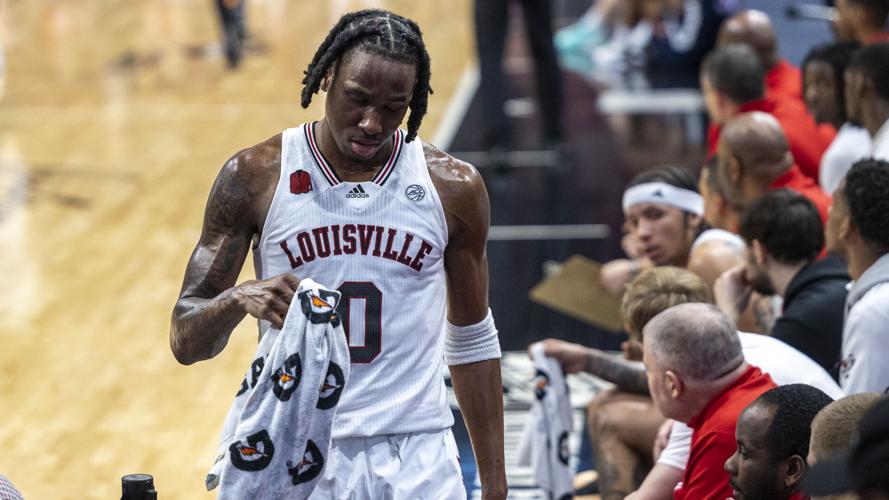
Mike James heads to the bench near the end of a loss to Virginia in the KFC Yum! Center on Jan. 27, 2024.
Payne has had less success in the transfer portal, which increasingly, is the key to rebuilding in college basketball. Brandon Huntley-Hatfield, his first portal addition last season, has emerged as really solid piece for Louisville. There just haven’t been enough of those. The portal was not quite so big a piece when Payne was last in the college game. And honestly, the speed with which it has come to shape the current landscape, along with NIL, have been game-changers.
On top of that, the losing, both last season and this, stand in the way of more. Louisville has one commitment for next season, T.J. Robinson, a three-star point guard from New Jersey. Karter Knox, the younger brother of former Kentucky standout Kevin Knox and a McDonald’s All-American, has visited Louisville, but it is competing with Kentucky, the G-League and South Florida.
And Louisville’s current situation doesn’t bode well.
A CLOSING WINDOW
It's a sad fact, but the pace of college basketball right now doesn’t allow a coach much time to build. With the transfer portal making complete roster revamps possible, there’s little patience for trying to build through high school recruiting, and the negativity that comes with a couple of years of losing at a historic rate is not going to make for a fertile recruiting environment.
The window is small, everywhere. At Louisville, given its historic success, the window is smaller still.
And for Payne, every half like the first half against Virginia on Saturday slams the window shut a little more.
My belief before the season was that if Payne was going to get things up and running, most people would feel it. There would be a consensus that last season was just a bad combination of factors and that the program and team would be on a much more solid footing from a talent and coaching standpoint than we saw a season ago. If that wasn’t the case, I figured there would be general agreement that things weren’t working, and weren’t on their way to working. There would be little gray area.
That, unfortunately, appears to be the case. While you can make a case for slight improvement, we’re still seeing much the same that we saw last season. Too much. And while I haven’t done any polling, I’d say the overwhelming opinion is that this hasn’t worked and that Payne's approval rating is under water, perhaps irreparably so.
The only saving grace is that I don’t sense a large split in the fan base. It feels as united in this opinion as it has been in anything.
I wrote back in early December that most of us could see what kind of collision course this program is on, the only variable is time.
WHAT HAPPENS NOW?
It remains difficult to see a scenario in which Payne returns for a third season. The question is what happens for the six weeks or so left in this season.
I’d still be surprised to see any move made in the season. If Louisville coaches were judged on results against Virginia, many would go wanting. Yet Payne has an entire body of work that doesn’t lend itself to a lot of leeway at this point.
Still, if the team shakes off that Virginia first half and gets itself back to its prior form, there are a few wins down the stretch of the season – though perhaps not many.

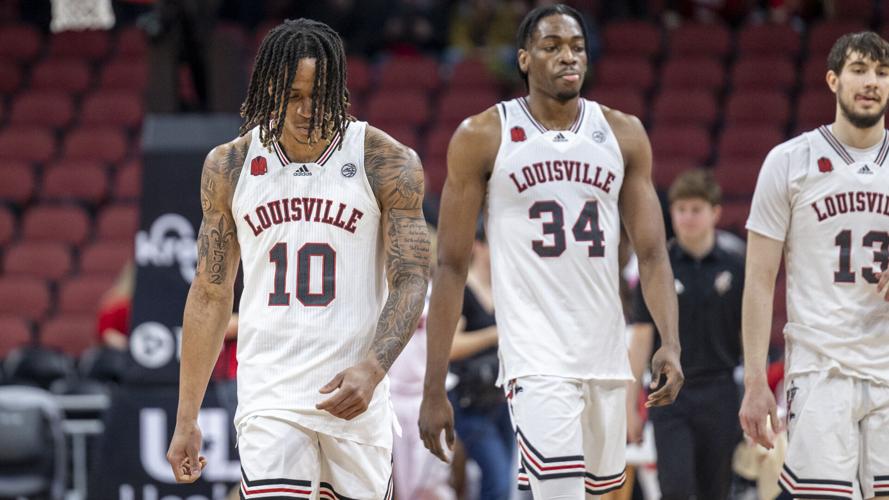
Louisville freshman Kaleb Glenn, sophomore Emmanuel Okorafor and sophomore Danilo Jovanovich walk off the court after a loss to Virginia in the KFC Yum! Center on Jan. 27, 2024.
It's a bleak scenario. The only good answer is winning, and that’s been an answer that Louisville hasn’t been able to provide. Not for a long time.
Since the dismissal of Rick Pitino, the program’s record is 91-94, though there were some good years under Chris Mack. Since the departure of Pitino-recruited players, the success level has dipped. Since Mack negotiated a midseason-exit, the record has been 12-52. Payne took over a team that had lost 15 of its past 18 games.
It was a tough spot, and tougher probably then even Payne knew. Yet he has not significantly improved on that spot, and in many ways, the program has flattened out, not begun the climb out of its hole. Sometimes that’s hard to tell from the bottom of the pit, but even so, the pit is never a good place to be.
Put simply, the program just can’t afford to wait around. It was a damaged brand when Payne arrived and the past two years have done little to fix that, and in fact may have hurt it more.
It has no choice but to endure whatever the rest of this season has to bring, either under Payne, or someone else if Heird can find a good alternative. If he can, he has more creative vision than I do. There are really no good in-season options, except to win, and that’s no more likely under an interim than under Payne.
Either way, there is something to be said for a unity of opinion, and in that, I feel pretty safe in saying most of us know where this is heading. It’s just no fun being here, or getting there.
I do feel bad for Payne. I do think he could use this experience, move to a school without hometown pressure, perhaps a Nike school, bring talent in, and turn himself into a winning college coach. In this business, you’re not supposed to root. But I’ll be honest. If this team could catch fire, win a bunch of games between now and the end of the season, get fans excited and change the narrative, I not only would love to see it, but believe it would be the best outcome for this program.
Payne being a great success here would be the best outcome for this program for a lot of reasons. But just because I believe that doesn’t mean I’m allowed to ignore the obvious: the program isn’t tracking toward success and damage continues to be done. That’s just reality.
My only suggestion for fans – surely to be roundly rebuffed – is to keep your heads up, and have confidence that the program as it now exists is not what it has historically been, and not what it will be.
It's just going to take a coach who can activate the support the program has historically had while attracting the kind of talent it has historically gotten and coaching it in an effective way to win basketball games.
Sounds easy enough. But all parts of that equation are important. Louisville basketball hasn’t added them up for a while, and the math, sadly for Payne, isn’t adding up right now.
Copyright 2024 WDRB Media. All Rights Reserved.