


LEXINGTON, Ky. (WDRB) — There are two kinds of people when the weather siren goes off.
Some head for the basement. Others start checking the radar.
Kentucky's new athletics director sounds like the second kind.
The first thing you notice about J Batt isn't what he says. It's what he doesn't say.
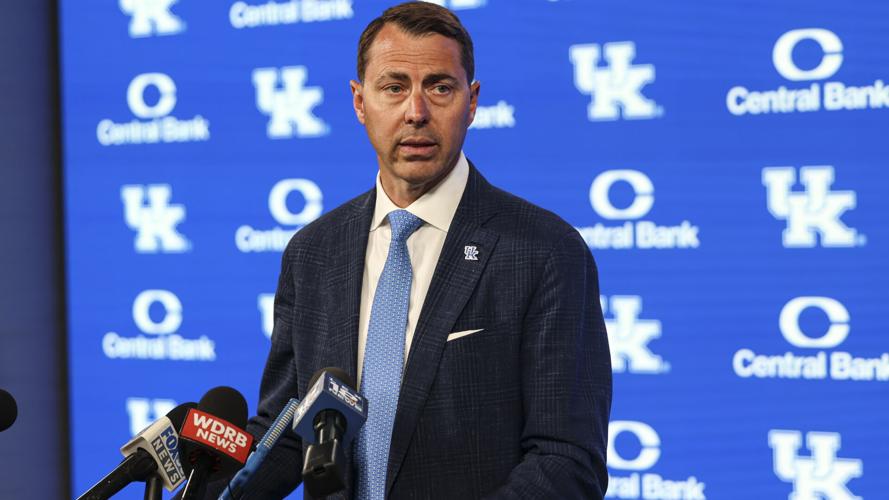
When he met with reporters after being named the next athletics director and CEO of Kentucky athletics, he didn't talk much about preserving tradition. He didn't spend much time reminiscing about the glory days. Nor did he sound like a man worried about what college athletics is becoming.
He sounded like a man who has already accepted what it has become.
Louisville | Kentucky | Indiana | Eric Crawford
And, more importantly, he sounds eager to get on with it.
College sports is currently changing faster than a teenager's mood. Athletes are being paid. Schools are becoming businesses. Congress is writing legislation. Courts are rewriting rules.
The NCAA spends most of its time trying to figure out whether it still has a job.
Many athletic directors discuss all of this the way a homeowner discusses termites.

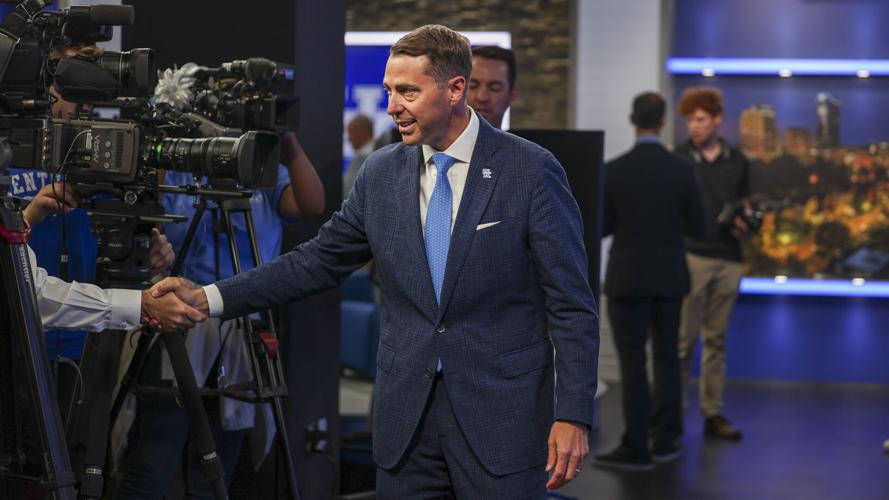
New Kentucky athletics director shakes hands with reporters in Lexington, Ky.
Batt discusses it the way a stockbroker discusses a bull market.
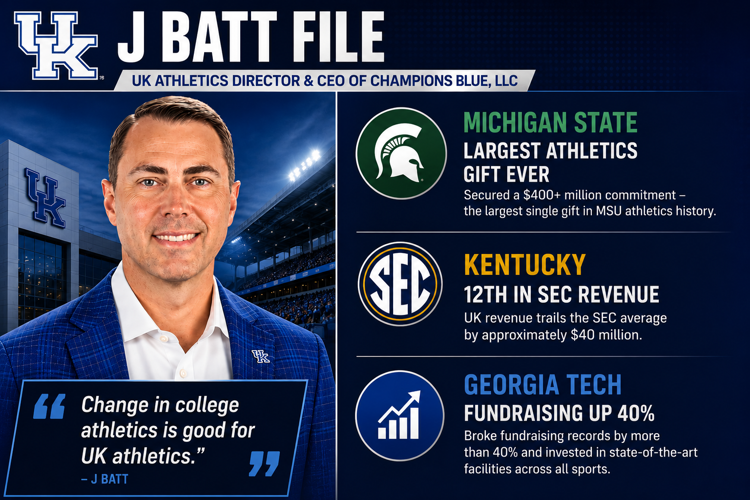
"Change in college athletics is good for UK athletics," he said.
Then he repeated it.
"Change in college athletics is good for UK athletics."
When somebody repeats a sentence the first time he talks to you, it usually means they want you to remember it.
Kentucky didn't hire a man preparing for change. Kentucky hired a man who thinks change favors Kentucky. That's a different thing entirely.
And it may be the most important thing he said.
Because if Mitch Barnhart's era was defined by stability and diversification, Batt's is likely to be defined by acceleration.
Barnhart spent more than two decades building one of the most respected athletic departments in America. He won championships. He hired coaches. He expanded facilities. He created consistency in a profession where consistency often lasts about as long as a carton of milk.
But the job he leaves behind isn't the same one he inherited.
The modern athletic director isn't just a steward. He's a fundraiser. A negotiator. A developer. A chief executive officer. Sometimes all before lunch.
Which is why it was revealing that Batt kept returning to the same themes. Revenue. Infrastructure. Flexibility. Alignment.
Not because those are exciting words. Because those are the words that run modern college sports.
The most frequently mentioned player at Batt's introductory press conference wasn't a player at all.
It was Champions Blue.
Kentucky's new business structure hovered over the entire event like a giant blue billboard.
Asked why he wanted the job, Batt pointed to Champions Blue. Asked how Kentucky would navigate change, he pointed to Champions Blue. By the end of the afternoon, it was difficult to tell where the athletic department ended and the business structure began.

Which, for a department that ranked No. 12 in the SEC in revenue in 2025, isn't the worst thing.
The message wasn't subtle. What also wasn't subtle: Batt has been preparing for this moment longer than most.
He served on the House Settlement Implementation Committee — a seat at the table while the rules of college athletics were actively being rewritten. That's not a credential you put on a résumé. That's a front-row seat to the future.
And he has already helped build parts of that future.
At Michigan State, Batt helped secure a commitment of more than $400 million — the largest single gift in college athletics history. He also helped launch Spartan Ventures, a nonprofit revenue structure that mirrors much of what Kentucky has constructed with Champions Blue.
He isn't inheriting a new model. He's been running one.
Kentucky believes it has built a vehicle for the future before many schools have figured out where the road goes. Maybe that's why Batt never sounded overwhelmed.
Most new athletic directors arrive talking about challenges. Batt kept talking about opportunities.
That's usually the language of somebody who thinks he has good cards.
Kentucky didn't hire him because he talks confidently about the future. Kentucky hired him because he has a reputation for paying for it.
The schools that thrive in the next decade won't necessarily be the schools with the biggest stadiums. They'll be the schools that can most effectively monetize the people sitting inside them.
"There certainly will be more revenue generating," Batt said. "The changes in college athletics will force us, and certainly be an opportunity for us to optimize revenue."
That sentence may not fit neatly on a T-shirt. But it probably explains his hiring.
In today's college sports economy, "optimize revenue" is just another way of saying "keep winning."
The most interesting answer of the day arrived near the end.
A question about development around Kroger Field. It was easy to hear it and move on. You shouldn't.
Batt discussed entertainment districts, extending game-day experiences and keeping fans in Lexington longer.
That's not merely a stadium conversation. That's an SEC conversation.
The future of college athletics isn't just inside arenas anymore. It's outside them. Restaurants. Hotels. Retail. Events. Experiences.
The game is becoming an ecosystem.
And Kentucky appears determined to build one with a man who has built one before.
There was something else noteworthy about Batt.
For a man stepping into one of the most scrutinized jobs in college athletics, he seemed remarkably comfortable not making news.
No grand declarations. No chest-thumping. No promises of banners in the rafters.
When asked about his first few weeks, he said he planned to listen and ask questions. That's usually a smart answer. Especially when you're inheriting a program that isn't broken.
Asked whether there was something unique about taking over a department already in strong shape, Batt smiled and called it exciting.
He knows Kentucky isn't a rebuilding project. He sees it as a launch pad.
Which brings us back to that weather siren.
College athletics is filled with administrators staring nervously at the clouds.
Kentucky just hired one who seems convinced the wind is blowing in his direction.
The storm is coming either way.
J Batt's first day suggested he believes Kentucky can fly faster than everybody else through it.
Copyright 2026 WDRB Media. All Rights Reserved.


