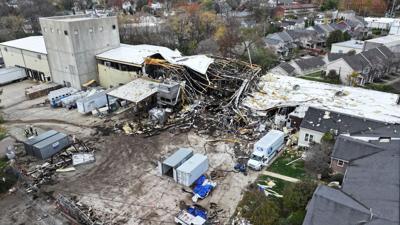


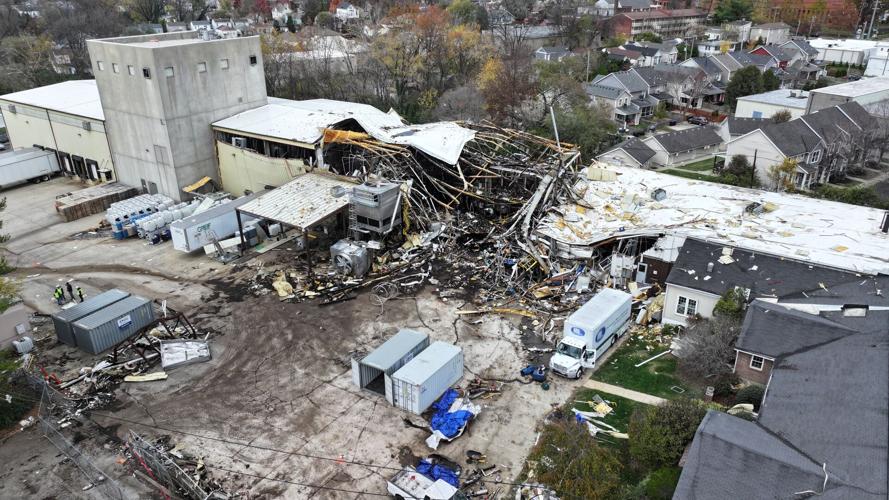
LOUISVILLE, Ky. (WDRB) — A U.S. regulatory board issued its final report Wednesday after its investigation of the fatal Givaudan plant explosion in Louisville, saying it was a "catastrophe waiting to happen."
The U.S. Chemical Safety and Hazard Investigation Board said the November 2024 explosion that killed two workers and seriously injured three others was caused by a reactor with an "overwhelmed" pressure release system, causing it to "rupture violently."
"The reactor's pressure relief system was not designed to release pressure from a reaction like this, and Givaudan did not recognize the potential for a runaway reaction to happen," CSB Chairperson Steve Owens said in a news release Wednesday.
The investigation found the explosion caused about $30 million in damage to the facility and another $10 million in damage to surrounding homes and businesses in the Clifton neighborhood. A state investigation found the issue that caused the reactor to explode had been documented months before.
Austin Jaggers, 29, and Keven Dawson Jr., 49, were killed in the explosion.
CSB previously investigated the 2003 explosion at the Payne Street facility when it was owned by D.D. Williamson & Co. before Givaudan's acquisition in 2021. The board concluded a vessel most likely failed after it overheated and exploded. One worker was killed.
As a result of that explosion, an outside consultant told D.D. Williamson in 2012 it needed to update its reactors with larger relief systems. At the time, the plant had four reactors. According to the CSB report released Wednesday, D.D. Williamson enlarged the relief systems for Reactors 3 and 4 in the plant but not Reactors 1 and 2. Then, in 2021, two additional reactors were installed — Reactors 5 and 6 — to increase the plant's capacity. Those reactors were built in California in 1978 for a D.D. Williamson facility that shut down in 2008.
Reactors 5 and 6 had to be modified to meet the needs of the Louisville plant. However, because they were similar in size to Reactor 2 and were to be used for a similar purpose, the relief systems for Reactors 5 and 6 were designed after that of Reactor 2 — creating a similar problem that, in part, led to the 2003 explosion.
"... the Louisville facility did not consider the 2012 caramel coloring reactivity testing results when designing the relief systems for Reactors 5 and 6," CSB said in its report. "As a result, the Reactor 5 and Reactor 6 relief systems were not designed to relieve the pressure that could be produced by the reaction identified in the 2012 testing or by the hazardous reaction of any other product recipes. In November 2024, Reactor 6 overpressured and ruptured when Product 484 ingredients experienced a runaway (uncontrolled) reaction resulting in a rapid temperature and pressure rise ..."
Former Givaudan worker Angelita Oldham, who worked at the Clifton facility but was not on shift at the time of the explosion, said Wednesday she was not surprised by the board's findings.
Oldham said she was one of the first workers to speak up after the blast about equipment issues, leaks and odors at the plant. She said she reported the issues to management, safety leaders and the OSHA before the explosion happened.
"(I was) scared, yes, that's almost an understatement. It was beyond scared. It was beyond scary," Oldham said. "Multiple things going on and they knew it... I'm just raising awareness because it should have been fixed. You had us coming in knowing that things were not functioning properly and I have a family as well."
Oldham said one of the workers who later died in the explosion warned her days earlier to stay away from the cooker involved.
"He said stay away from the cooker," Oldham said. "It should not have been cooked on."
What happened
According to the CSB investigation, problems at the plant started around 2 p.m. Nov. 12, the day of the explosion, when a cooking vessel started to over-pressurize. The pressure relief valve was opened, the report said, and pressure decreased and maintained its normal levels for 16 minutes.
The report cites process data indicating the vent valve of the vessel was commanded to fully open at 2:40 p.m. Investigators said the purpose of that was to reduce pressure. But the pressure continued to rise even after that command.
In an attempt to get the pressure and temperature down, workers added cooling water to the coils of the vessel at 2:49 p.m. However, both continued to rise until the pressure relief valve was opened at 2:54 p.m., temporarily reducing the pressure. But the temperature and pressure continued to rise until it was too late and the cooker exploded at 2:57 p.m.
Three seconds later, the report says, video and data feeds are lost when the explosion occurs.
Following the explosion, investigators found the cooker's automated vent valve was almost fully closed.
Investigators noted that before the explosion, the maximum temperature on the vessel was 385 degrees Fahrenheit, which they said was 30 degrees above the "maximum allowable working temperature" of 355 degrees. The maximum pressure before the explosion was 237 psig, more than three times the maximum of 75 psig.
"This tragedy demonstrates that companies handling reactive chemical processes must fully understand the hazards of their materials, implement effective safeguards, and ensure that workers and surrounding communities are protected from catastrophic events," CSB Board Member Sylvia Johnson said in a news release.
The plant was demolished earlier this year. Givaudan doesn't plan to rebuild in Louisville.
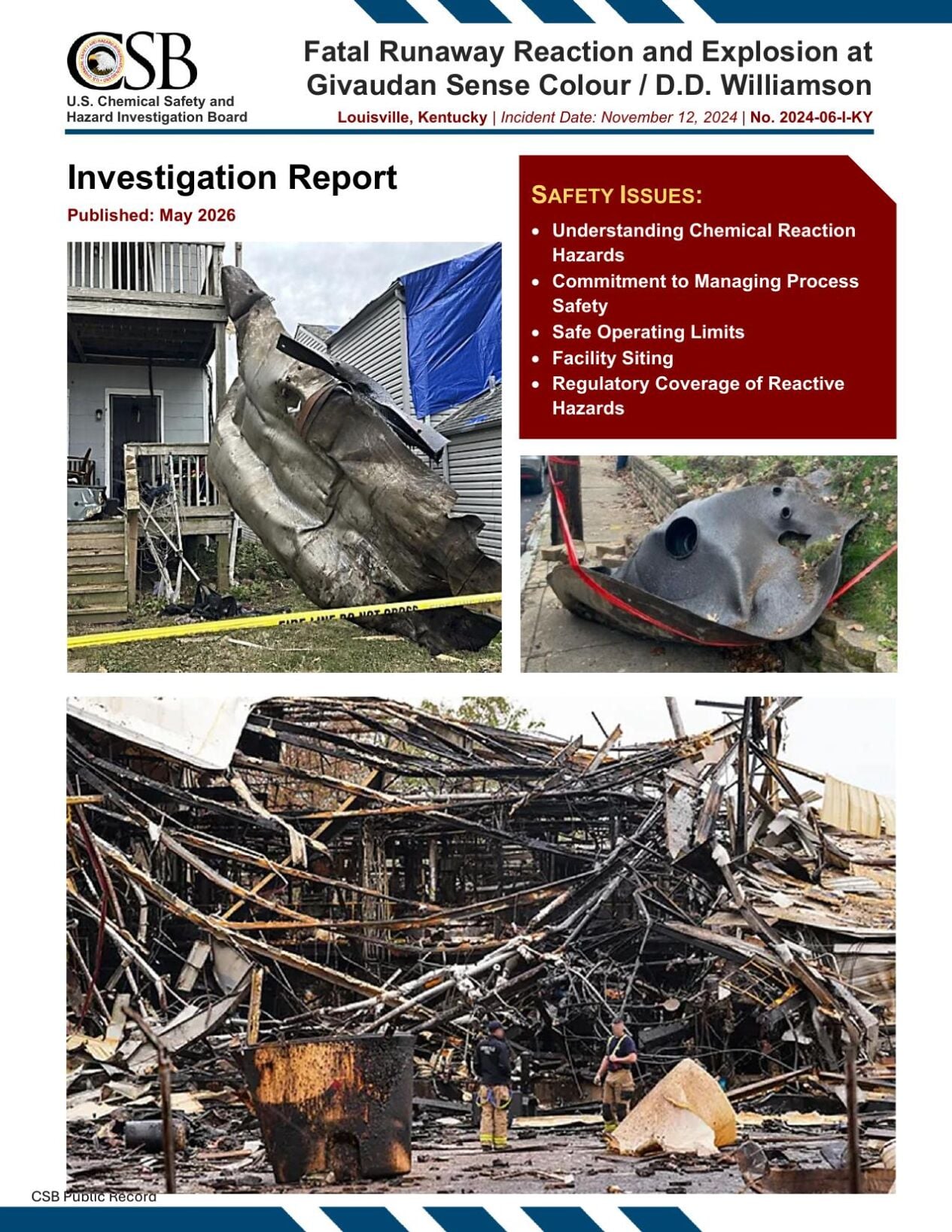
You can read the full report below:
Copyright 2026 WDRB Media. All Rights Reserved.


